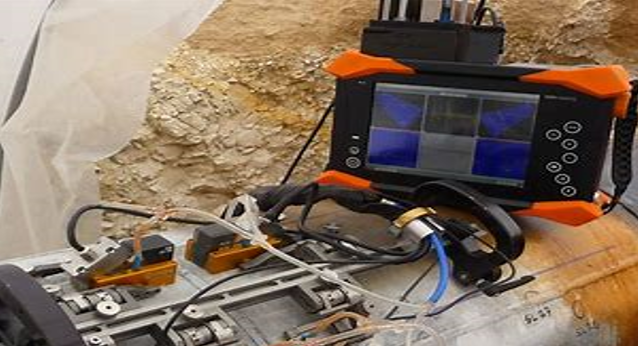
- ⇾ Phased Array Ultrasonic Testing (PAUT): PAUT uses multiple ultrasonic elements to generate focused, controllable sound beams. It's used to inspect welds, pipelines, and structural components for internal defects with enhanced accuracy and speed. PAUT can provide detailed information about the size, shape, and location of defects.
- ⇾ Time-of-Flight Diffraction (TOFD): TOFD is an ultrasonic technique that's particularly effective for detecting and sizing cracks, as well as assessing their orientation and location within materials. It's commonly used for weld inspections and can provide accurate defect sizing and positioning information.
- ⇾ Acoustic Emission Testing (AE): AE detects and analyses acoustic emissions from materials under stress or deformation. It's used to monitor the integrity of structures and detect defects or cracks that might be evolving over time.
- ⇾ Advanced Visual Inspection (AVI): AVI involves using specialized cameras, remote-controlled systems, or drones equipped with high-resolution cameras to capture visual data in difficult-to-reach or hazardous areas. This provides a thorough visual assessment of structures and components.
- ⇾ Advanced Rope Access Techniques: Combining advanced NDT techniques with rope access methods allows inspectors to reach challenging locations on offshore platforms or vessels, enabling thorough inspections without major disassembly or equipment removal.
- ⇾ Thermal Imaging (Infrared) Inspections: Thermal imaging is used to detect temperature variations that could indicate issues such as electrical faults, insulation problems, and mechanical defects in marine and offshore units.
Advanced NDT techniques provide more accurate and detailed information, allowing operators to make informed decisions about maintenance, repairs, and overall safety. They are particularly valuable in marine and offshore environments where structural integrity is crucial and conventional methods might be insufficient.